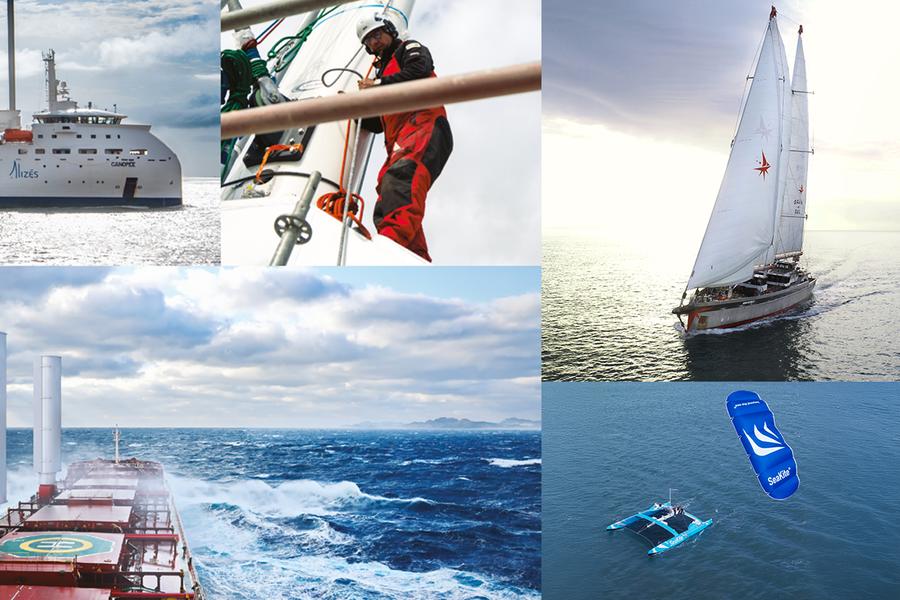
Wind Propulsion Report
Charting a sustainable course for shipping
Preparing for a new Age of Sail
Ships have been harnessing the power of wind for generations. However, with the rise of steam and then diesel engines, wind propulsion has faded to the background over the last 150 years.
With global climate targets fast approaching, wind power is once again an appealing option for shipowners, thanks to its emission-free and inexhaustible nature. Although obstacles remain to its wider uptake, wind propulsion has the potential to change the way the maritime industry moves.
Key Figures
Why wind propulsion?
Thanks to its multiple advantages compared to other systems, wind has an important role to play in decarbonizing the maritime sector.
Wind propulsion systems onboard ships can enable significant energy savings. They also reduce carbon dioxide (CO2), nitrogen oxide (NOx) and sulfur oxide (Sox) emissions. Furthermore, wind power can minimize engine vibrations that cause underwater radiated noise, which harms the ocean ecosystem.
In the long term, wind propulsion systems also offer potential economic benefits for shipowners and operators. Although the upfront costs of installing these systems tend to be high, they can actually lower operating costs once fully functional through decreased fuel consumption.
Assessing suitability for ships
Thanks to technological advancements, a wide range of modern wind propulsion systems are on the market or under development. These systems can generally be categorized into two types:
- Active systems, which require external energy for thrust generation. This includes rotor sails and suction sails.
- Passive systems, which rely solely on wind energy. This includes wing sails, sailing rigs, rigid sails and kite sails.
Many of these technologies make use of automation, weather routing, energy management and other advancements, offering a range of options for equipping modern ships with wind propulsion capabilities.
Technology Leader, Sustainable Shipping
Bureau Veritas Marine & Offshore
“There is something charming about the idea that wind-assisted propulsion is cutting-edge when sails are the original shipping technology. Of course, today’s sails are designed to work onboard modern, connected vessels, but the principle is the same: using a clean energy source to get ships where they need to go, safely and sustainably.”
Type of wind propulsion technology
-
Sailing rigs
Soft sail rigging systems are the oldest wind technology, dating back millennia. The sails are mounted on masts and operated with ropes or cables (sheets).
Various rig configurations exist, including several modern developments. These include traditional rigs, modern rigs, modern square rigs, free-standing rigs and balestron rigs. Each of these rigging configurations include a type of mast and sails of different shapes.
-
Rotor sail
A rotor sail is a rotating cylinder mounted on the deck. Onboard electricity generally powers the motors that spin the cylinders.
Rotor sails generate forward lift using the same principle as curveballs in sports: the Magnus effect. This is a phenomenon in which a spinning ball (here a cylinder) curves away from its principal path. Due to friction, when a cylinder is rotating in an air flow, the fluid is accelerated on the upper part and slowed on the lower part. The acceleration on the upper part reduces pressure, whereas the slower flow on the lower part increases pressure. This difference in pressure pushes the rotor sail forward and propels the ship.
-
Suction sail
Suction sails, also known as ventifoils, use a vertical cylinder with a flap, along with a suction system with a propeller inside to improve efficiency.
In suction sails, the non-rotating cylinder acts as a wing to generate thrust. To improve lift across a range of angles of attack, the cylinder is equipped with fans and a flap at the back of the wing, which can be moved to either side to adjust the air flow to maintain lift.
The fans pull air into the cylinder, increasing the depression on one side of the wing to create a pressure difference that results in forward thrust. Air suction is created using fans driven by electric motors. The angle of rotation is automatically adjusted in line with the wind.
-
Wing sail
Wingsails are based on the aerodynamic design of airplane wings. They use their cross-sections to generate thrust based on the Bernoulli principle.
The advantage of wingsails over traditional sails is their camber aerodynamic shape, which provides enhanced lift and a better lift-to-drag ratio.
There are two main types of wingsails:
- Soft wingsails, which are made of flexible materials like sailcloth.
- Rigid wingsails, which have rigid surfaces typically made of carbon fiber and are usually thicker than soft wingsails.
-
Kite sail
The kite is a wing surface that flies at high altitudes, benefiting from constant, strong winds.
Kite sails generate lift and propel the ship through one or more lines connecting to the ship. The kite operates upwind in a stable position and downwind in a dynamic figure-eight flight pattern to enhance performance.
The kite system comprises a system for launch and recovery, a control system, the kite itself (an elliptical soft wing), a control pod, control lines, ropes and winches. The kite can be retracted and secured during unfavorable wind or extreme conditions.
Bureau Veritas Rules
Bureau Veritas is helping develop safe, sustainable wind propulsion methods and technologies. BV NR206 classification Rules for wind propulsion address safety and reliability from design review through to installation and operations, including maintenance and surveys. These rules help verify that clients have undertaken all necessary technical and safety measures before adopting wind propulsion systems.
Bureau Veritas has also developed two notations for wind-assisted propulsion, which provide load cases and coefficients for freestanding rigs, wing sails, kite sails and wind turbines. The WIND PROPULSION-1 notation is for wind-powered ships with standing rigging, and the WIND PROPULSION-2 notation concerns vessels with both standing and running rigging.
Frequently asked questions
-
Which ships can use wind propulsion systems?
Wind propulsion systems generally work best on ships that have a high sail area to displacement ratio. This means that wind propulsion has particularly strong potential for smaller ships, as their lower propulsive power requirements can be more efficiently met by wind propulsion systems.
These systems can also be used on larger ships, especially considering their greater deck space. Since the size and power requirements of these ships is generally much greater, wind propulsion is more likely to be used as a secondary, rather than primary, means of propulsion. This can, however, still enable increased energy efficiency.
-
How can wind propulsion systems be optimized?
The efficient operation of a wind-powered ship relies on effective energy management. On ships with engines and wind propulsion systems, the wind energy supplements engine power. This increases energy efficiency by reducing fuel consumption, emissions and the engine load. When combined with other measures, such as weather routing and route optimization, the gains can be even greater.
Routing studies have demonstrated that, at certain times, it can be more efficient to convert wind energy into electricity rather than to use it to propel the ship directly. This is an alternative use of wind systems that can work in tandem with their principal use as a means of propulsion in the right weather conditions.
-
Has Bureau Veritas collaborated on any notable wind propulsion projects?
Bureau Veritas classed the CANOPÉE, one of the most innovative projects for wind-assisted propulsion projects to date. This wind-propelled cargo ship, jointly owned by Zephyr et Borée and Jifmar Offshore Services, was built to transport ARIANE satellite launcher components from Europe to French Guyana.
Our experts are also involved with the Ville de Bordeaux, a 20,000 DWT ro-ro cargo vessel with a kite system fitted onboard, owned by Louis Dreyfus Amateur's.
On the development side, we delivered an Approval in Principle to Chantiers de l'Atlantique for their Solid Sail wind propulsion system. This project aims to develop a rigid sail made of glass-polyester panels that can be installed onboard large cruise ships.
-
How can shipowners improve their EEDI and EEXI ratings with wind propulsion?
The Energy Efficiency Existing Ship Index (EEXI) and Energy Efficiency Design Index (EEDI) are determined as the ratio between calculated CO2 emissions and the transport capacity of the ship design. Under these requirements, wind propulsion performance is addressed separately from overall ship performance.
However, the IMO’s 2021 Guidance on treatment of innovative energy efficiency technologies for calculation and verification of the attained EEDI and EEXI does provide relevant guidance. It outlines the process for determining the force matrix of wind propulsion systems and demonstrates their contribution to EEDI and EEXI calculations. The figure below sets out the role that wind propulsion plays in these calculations, specifically through the reduced fuel consumption that it makes possible.

-
What barriers hinder the financing of wind propulsion systems?
Shipowners pursuing decarbonization can align with frameworks such as the Poseidon Principles and the UN Net-Zero Banking Alliance to showcase green investments and contribute to a sustainable future.
However, market and non-market barriers – limited information, industry conservatism and short-term profit focus – hinder the broader adoption of wind technologies. This prevents the sector from realizing associated socioeconomic and climate benefits and perpetuates market failures.
Advisory Services
Through our technical advisory consultancy arm, Bureau Veritas Solutions Marine & Offshore, we help shipowners benefit from wind propulsion technology.
Our methodology enables shipowners to determine the right solution for their vessel, in terms of cost, safety, feasibility and efficiency. With longstanding expertise in complex computational fluid dynamics studies, our teams help ensure highly accurate assessments of a wind propulsion system’s impact on ships. We are also developing new methodologies for assessing the performance of wind propulsion technology, to support our customers even further in their decision-making.
Download the report
Learn more
 |  |  |  | ||||
Decarbonization Trajectories Report | Future shipping team | Alternative Propulsion & Future Fuels | OptiCARBON™ | ||||
| Liquefied natural gas (LNG) is the transitional fuel of choice for marine stakeholders as the world moves towards net-zero emissions. Global demand for LNG has led to huge investments in production, infrastructure and the international development of distribution networks, fueling increased demand for LNG shipping. | The shipping industry is reducing emissions and making the transition to a lower-carbon future. One of the key steps being taken in that transition has been the development of LNG-fueled shipping, and the rise of large LNG Bunkering Vessels. | To meet ambitious targets set by the International Maritime Organization for limiting emissions and environmental impact, many ship owners are turning to low carbon fuels and alternative propulsion methods. We break down the state of the technology and how we can help shipowners implement it. | OptiCARBON™ is an integrated platform for shipowners and operators designed to optimize fuel and tax costs as well as emissions management. Backed by the expertise of Bureau Veritas, the platform is a resource for maritime stakeholders working to perfect their emissions strategies. | ||||
|


