
UK ETS now applies to maritime: what you need to know
What is the UK ETS?
The UK Emissions Trading Scheme (ETS) aims to incentivize certain sectors, including maritime, aviation, power and heavy industry, to decarbonize by setting a cap on emissions from those sectors and creating a carbon price. Companies are required to surrender allowances equivalent to their emissions. They can purchase these allowances via state auctions or on the secondary market. The UK ETS will create a cost-effective path to net zero for the sectors covered under the scheme.
How does the UK ETS apply to the maritime industry?
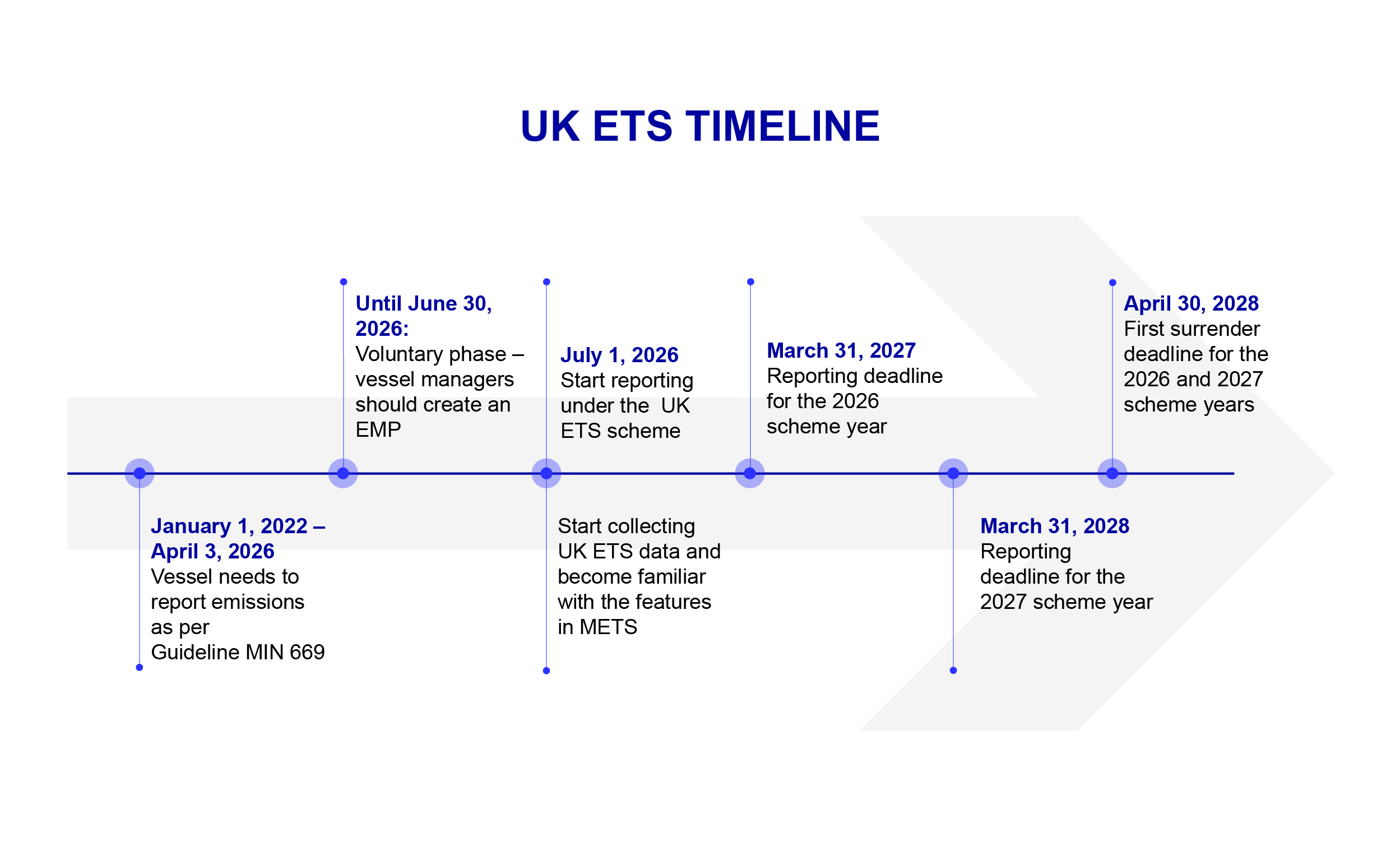
The scope of the UK ETS is being expanded to include maritime as of July 1, 2026. Offshore vessels have been granted a six-month transition window, with compliance becoming mandatory on January 1, 2027.
The UK ETS framework applies to any commercial shipping company operating cargo and passenger vessels of 5,000 GT and above that meet the following operational conditions:
- Ships undertaking a voyage between two UK ports
- This excludes journeys to or from Crown Dependencies and British Overseas Territories
- In-port operations
- Any qualifying vessel undertaking commercial activities within a UK port of call, irrespective of whether the preceding or subsequent part of the voyage is domestic or international
Regulated entities must purchase and surrender UK emissions allowances (UKA) equivalent to their verified annual greenhouse gas emissions. In addition to carbon dioxide, methane and nitrous oxide emissions must also be counted and converted into carbon dioxide equivalents.
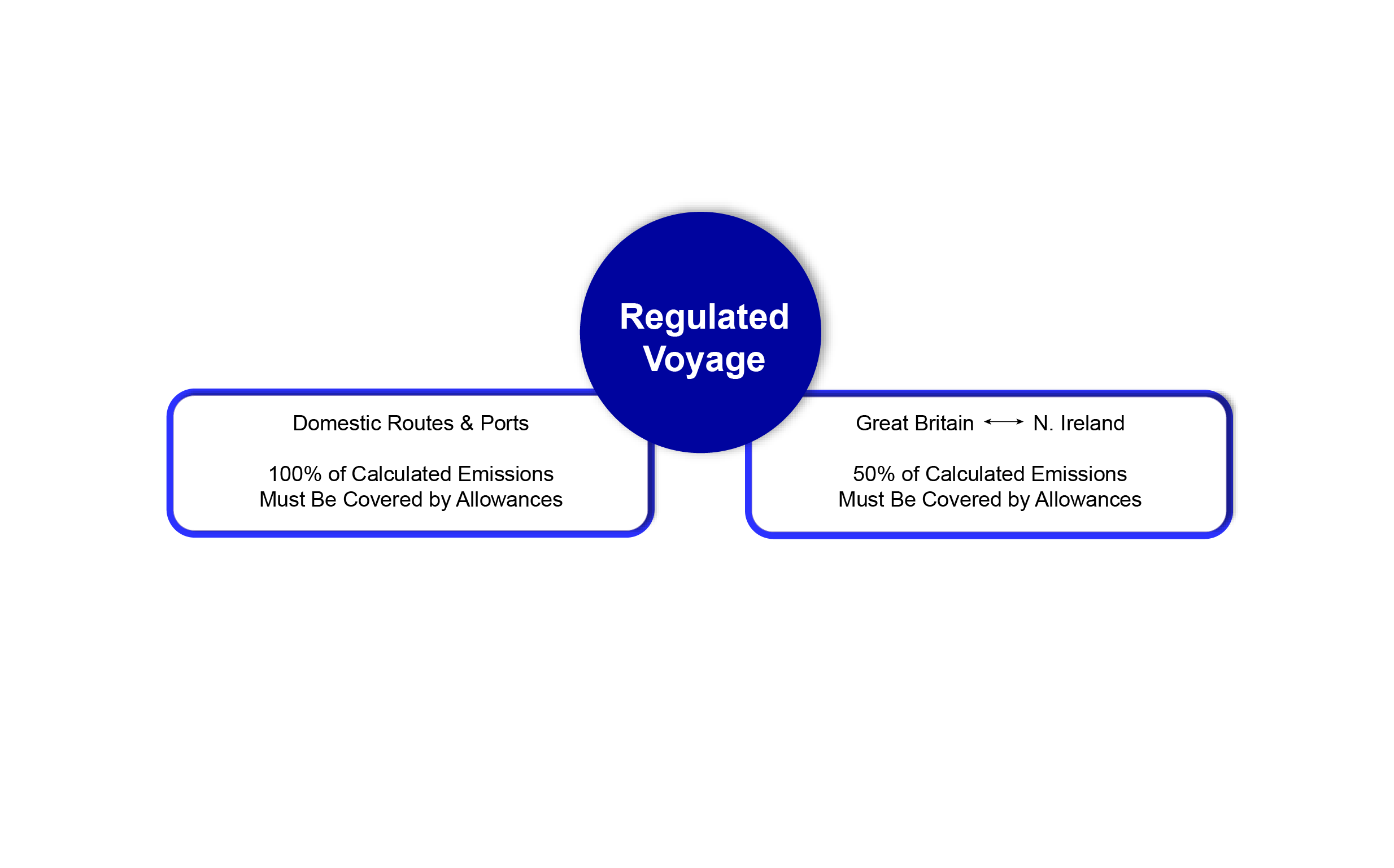
Routes between ports in Great Britain and routes that go between ports in Great Britain and Northern Irelands have different emissions requirements. The below infographic provides more information.
What port activities are covered by the UK ETS?
Vessel managers must account for all emissions generated during a port stay, including while a ship is at berth. The regulation explicitly covers:
- Hoteling: stationary periods where the vessel is moored or anchored while maintaining onboard auxiliary power during a regulated voyage
- Cargo operations: loading, unloading and related logistics performed within port boundaries
- Internal movements: any vessel shifting or transit maneuvers executed within the physical limits of a UK port
What steps do vessel managers need to take to ensure compliance with the UK ETS?
There are five key steps that shipowners and operators should take to ensure compliance with the UK ETS:
- Assign legal responsibility
- The registered owner is held legally accountable for UK ETS compliance by default.
- Responsibilities can be delegated to an international safety management (ISM) company. This requires a formal, signed written agreement executed by both parties, which must be submitted to and accepted by the national regulator.
- Activate your digital management account
- All operators must open a centralized digital account via the Manage Your UK ETS (METS) system.
- The UK Environment Agency currently supports early onboarding for the METS platform prior to July 1, 2026. Early onboarding allows companies to secure preliminary approval for their compliance pathways before the UK ETS enters into force for the maritime industry.
- Create an emissions monitoring plan (EMP)
- The EMP differs from EU ETS and FuelEU Maritime requirements in that it must be compiled strictly at a company level. Maintaining standalone plans for individual ships is no longer required.
- Assigned national regulators hold sole authority over the approval of the monitoring plans. Third-party verifiers are completely independent of this specific phase and are not involved in the approval of the EMP.
- Monitor and report
- The company must start monitoring voyages that fall under the UK ETS scheme. It must monitor the following for each applicable voyage:
- port of departure
- date and hour of departure
- port of arrival
- date and hour of arrival
- total amount of each type of fuel consumed at sea and in port
- emission factor for each type of fuel consumed
- amount of each greenhouse gas emitted
- The company must start monitoring voyages that fall under the UK ETS scheme. It must monitor the following for each applicable voyage:
- Verify annual emission reports
- The company should submit the collected data to an accredited verifier for verification.
- The collected data will be submitted on METS once the platform is launched.
Which vessels and activities are exempt from UK ETS requirements?
The regulation permanently exempts certain public, protective and specialized non-cargo vessel categories:
- Armed services ships and law enforcement vessels
- Government surveillance, marine protection and coastguard/search-and-rescue craft
- Navigation/safe passage support vessels and medical emergency response craft
- Fishing vessels and dedicated fish processing vessels
- Publicly funded research vessels, non-mechanically propelled ships and primitive wooden ships
- Dedicated Scottish ferry services
Excluded activities under the UK ETS include those performed exclusively for:
- military purposes
- search and rescue purposes
- firefighting
- providing humanitarian aid or assistance
- carrying out any other government function
- the transport, on official mission of a reigning Monarch and their immediate family, or a head of State of a State other than the UK
- the transport, on official mission of Ministers of a national government of a country other than the UK
What is the timeline for full UK ETS implementation?
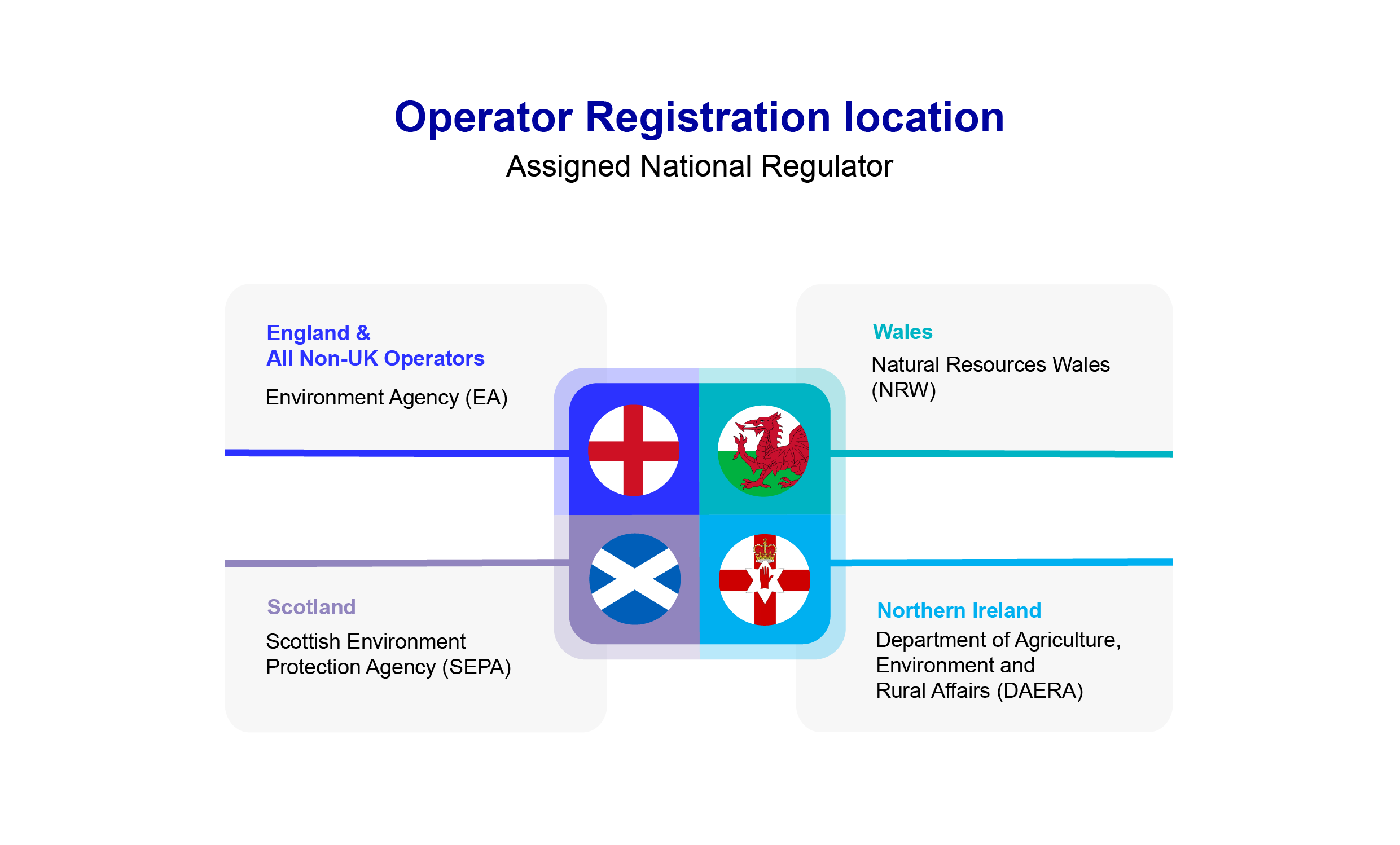
How do shipowners and vessel managers know who their UK ETS regulator is?
Administrative oversight is divided among four distinct regional regulators based on the vessel operator’s corporate registration address. See the infographic below for more information.
The regulators can be contacted via the following email addresses
England and outside of the UK: | |
Wales: | |
For correspondence in Welsh: | |
Scotland: | |
Northern Ireland: |
How does Bureau Veritas support compliance with the UK ETS?
As an independent verification body accredited by the UK Accreditation Service (UKAS), Bureau Veritas stands ready to assist shipowners and vessel managers in ensuring compliance with the UK ETS. By providing comprehensive pre-verification data assessments, data verification pipelines and final data verification for annual emissions reports, we help clients ensure complete reporting transparency and avoid non-compliance.
Find out more about our verification services for UK vessel owners and managers here.
You can find guidance videos about the METS platform here: | |
For queries relating to METS, contact the UK Environment Agency’s relevant service here: | |
For queries on the UK ETS registry, contact the UK Environment Agency’s relevant service here: |


