FuelEU Maritime
WHAT IS FUELEU MARITIME?
FuelEU Maritime is an EU law promoting the use of renewable and low-carbon fuels and speeding up their large-scale production. It has fully applied since January 1, 2025. It is part of the Fit for 55 package of legislation, which will enable the European Union to reach its target of carbon neutrality by 2050.
The FuelEU Maritime regulation aims to drive demand for renewable fuels and ensure fair competition between operators and ports during the fuel transition. To reach the EU’s targets, renewable and low-carbon fuels (RLF) should represent 86-88% of the international maritime transportation fuel mix by 2050.
The FuelEU Maritime regulation’s two key targets areas are:
- Mandatory use of onshore power supply (OPS) or other technologies offering equivalent environmental benefits at berth in an EU port for calls lasting more than two hours
- Greenhouse gas (GHG) intensity limits on energy used onboard ships
-
WHAT IS THE NEXT LEGISLATIVE STEP FOR FUELEU MARITIME?
FuelEU Maritime Regulation 2023/1805 was published in the EU Official Journal on September 22, 2023. Articles 8 and 9 on monitoring plans have applied since August 2024 and the entire regulation has fully applied since January 1, 2025.
As a regulation, FuelEU is directly enforced in all European Union member states without national transposition.
Starting on December 31, 2027, the European Commission will report to the European Parliament and the Council of the European Union on the effectiveness of this regulation every five years, as part of its periodic revision. The reports will cover:
- Market distortions
- Advancements in zero-emission technologies and renewable fuels for maritime transport
- Revenue from FuelEU penalties
- The regulation's impact on the European Union's maritime sector competitiveness
-
TO WHICH SIZES AND TYPES OF SHIP DOES FUELEU MARITIME APPLY?
Since 2025, FuelEU Maritime includes ships of 5,000 Gigatonnes and above, regardless of their flag. In the future, the regulation’s scope may also include smaller vessels.
As for voyages, FuelEU Maritime applies to:- 100% of energy used for voyages between two European Union (or European Economic Area) ports of call and at berth
- 50% of energy used for voyages between an EU (or EEA) port and a non-EU destination
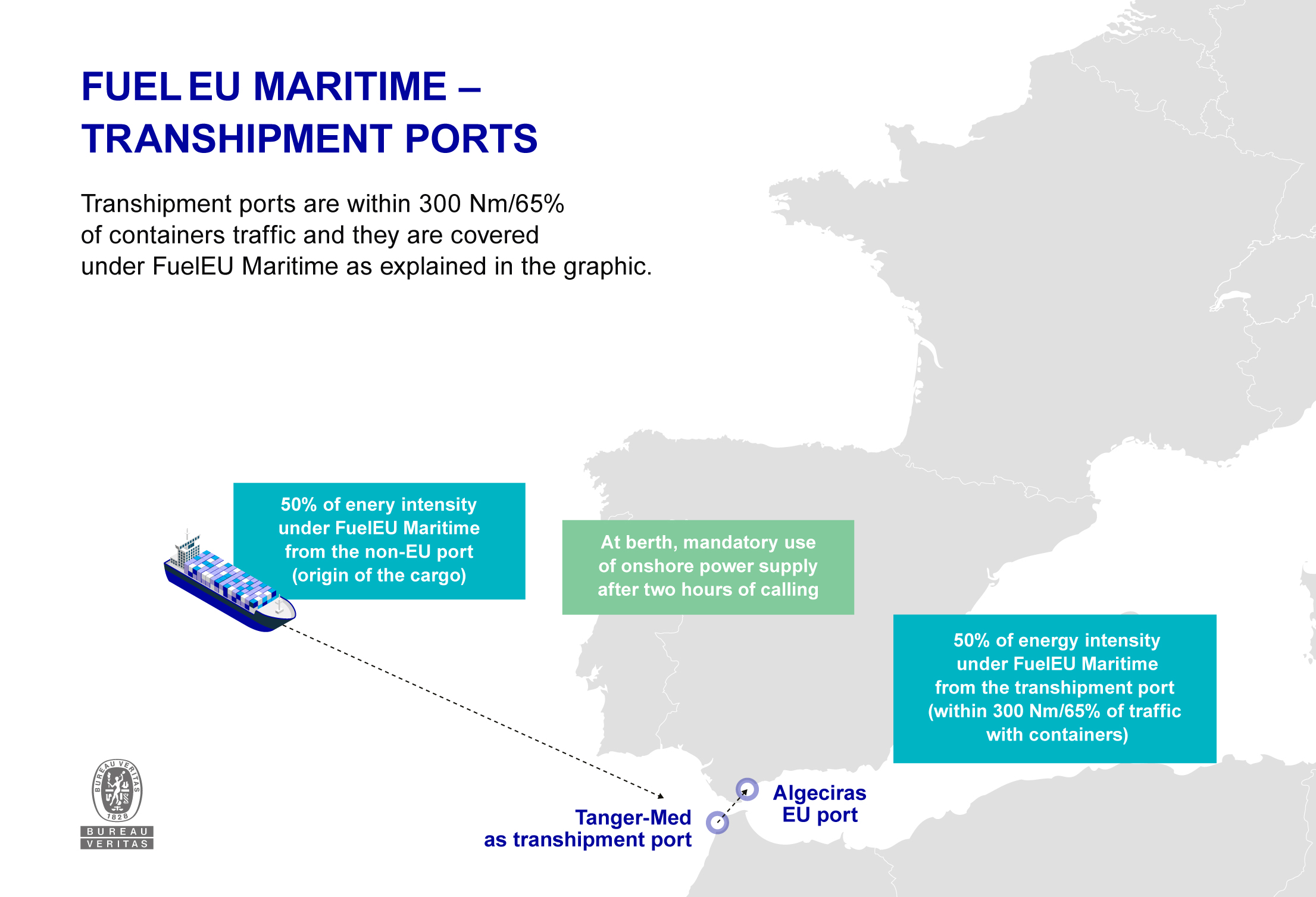
Transhipment, which is the unloading and storing of containers at an intermediate port before reloading to a different vessel, is also covered under FuelEU Maritime if:
- It occurs within a zone of 300 nautical miles
- The share of transhipment containers exceeds 65% of total container traffic at the relevant port
FuelEU Maritime applies to 50% of the energy used between the extra-EU port of origin or destination and the EU (or EEA) port in question.
-
What are FuelEU Maritime’s yearly targets and key requirements?
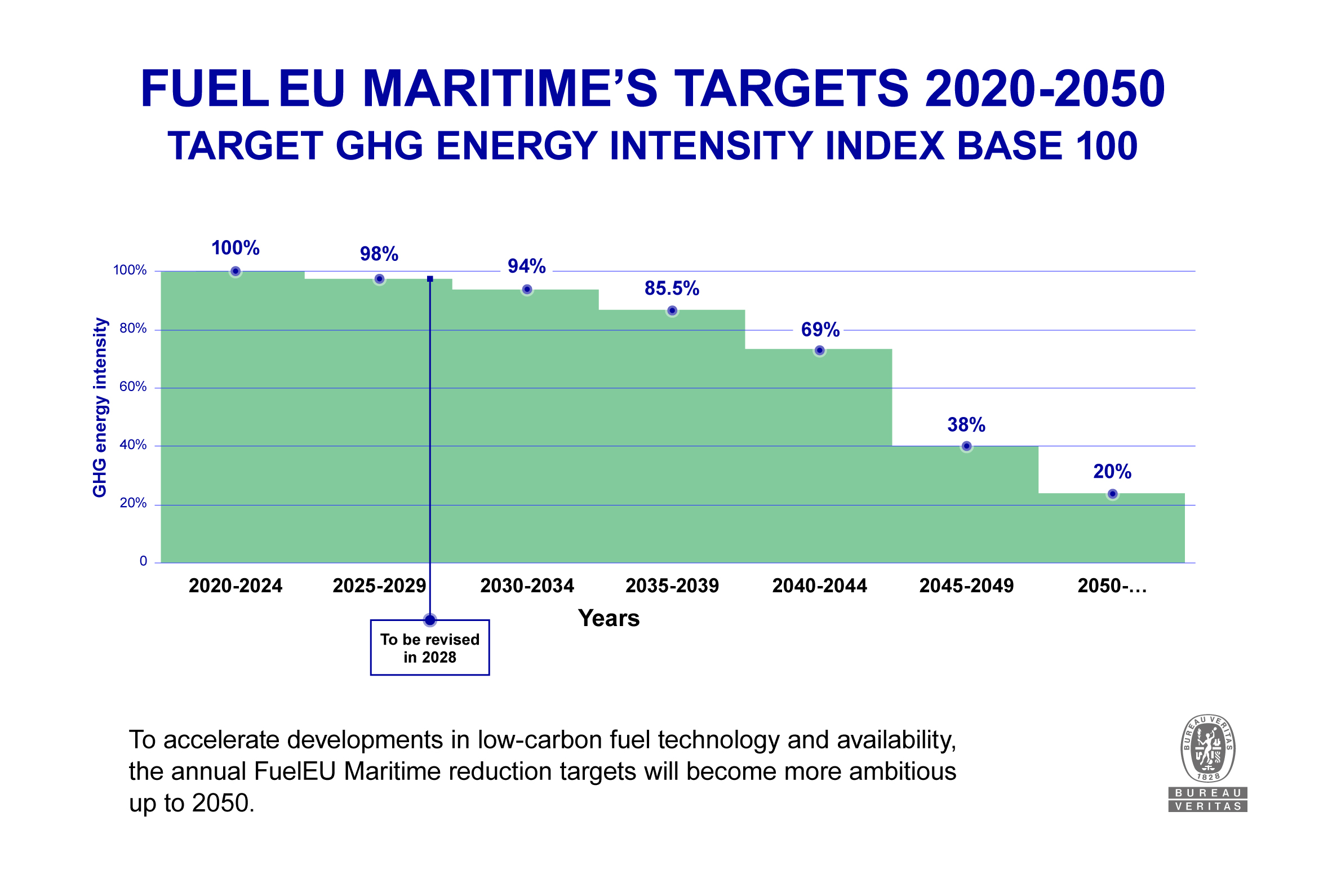
The annual reduction targets become more ambitious every five years until 2050 to reflect developments in low-carbon fuel technology and availability:
2% by 2025
6% by 2030
14.5% by 2035
31% by 2040
62% by 2045
80% by 2050
This means onboard energy will be subject to the following GHG intensity limits:
Download our infographic
The EU began incentivizing renewable fuel use in 2025 and will continue until 2034. They provide credits for ships using renewable fuels of non-biological origin (RFNBO), such as e-fuels produced using renewable electricity. By 2034, at least 2% of yearly average onboard energy should be met by such fuels.
The use of Onshore Power Supply (OPS) at berth will apply as follows:- Container and passenger ships at quayside in Trans-European Transport Network (TEN-T) core and comprehensive network ports from 2030
- Container and passenger ships at quayside in all EU ports (or EEA) where the quay is equipped from 2035
-
DOES FUELEU MARITIME APPLY TO ALL TYPES OF GHG EMISSIONS?
The FuelEU framework adopts a well-to-wake (WtW)approach to emissions. Three types of GHG emissions are included in its scope:
- Carbon (CO2)
- Methane (CH4)
- Nitrogen oxide (N20)
FuelEU’s default emissions factors will address fossil fuels, but biofuel and biogas emission intensity will be determined by the Renewable Energy Directive (RED).
Shipping companies need to calculate GHG emissions per unit of energy used on board, based on their reported fuel consumption and the emissions factors of their respective fuels. -
WHAT ARE THE DEROGATIONS OR EXEMPTIONS FROM FUELEU MARITIME?
The following cases of energy use will be exempt up until December 31, 2029:
- Small island passenger ships: Non-cruise passenger ships providing transportation services between ports of call under the jurisdiction of the same member state when one port of call is located on an island with fewer than 200,000 permanent residents
- Outermost region routes: Energy used between two ports of call in outermost regions of the EU (such as the Azores, Canary Islands, Réunion, French Guyana, etc.) and the energy used during their stay in port
- Public Service Obligation (PSO) routes: Passenger ships already operating before this regulation came into force on specific routes between their mainland ports of call and ports of call under their jurisdiction located on an island or the cities of Ceuta and Melilla
Ice-classed ships and ships sailing in ice will also benefit from a reduction factor in the GHG intensity of energy used onboard until December 31, 2034.
There are three exemptions from the mandatory use of OPS:
- Emergency situations: In unscheduled port calls, for emergency, safety and lifesaving reasons. This exemption must be certified by the administrating body of that port
- OPS unavailability: If OPS is unavailable or incompatible in a port of call before 2035
- Short stays: Ships staying at port for less than two hours
-
HOW DO I ACHIEVE COMPLIANCE WITH FUELEU MARITIME?
Shipping companies must consider several factors when it comes to FuelEU Maritime compliance.
Monitoring and reporting GHG intensity
For shipping companies :
- Each individual ship will need its emissions reported in a new database
- The shipping company is responsible for monitoring the type and amount of energy used at port and in operation
- They must record the well-to-wake (WtW) emissions factors for all of their fuels
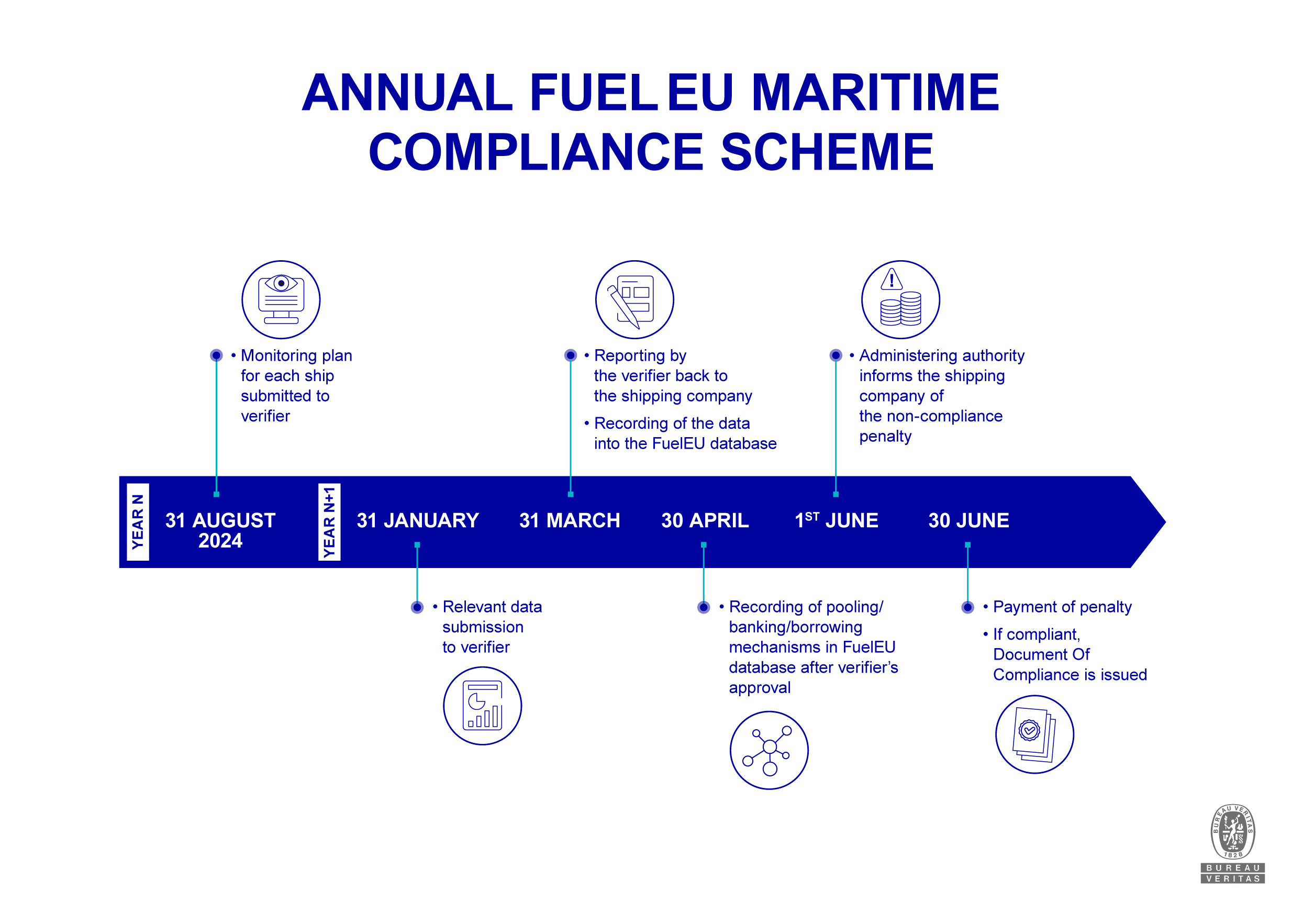
- They must submit their emissions data to the verifier by March 31 each year
For verifiers:
- Verifiers will assess each monitoring plan and calculate the yearly average GHG intensity for a ship’s onboard energy use and OPS, and how this compares to annual targets
- They will issue a document of compliance annually in June, to be kept onboard all ships calling at EU ports throughout the reporting period
Borrowing, banking and pooling mechanisms
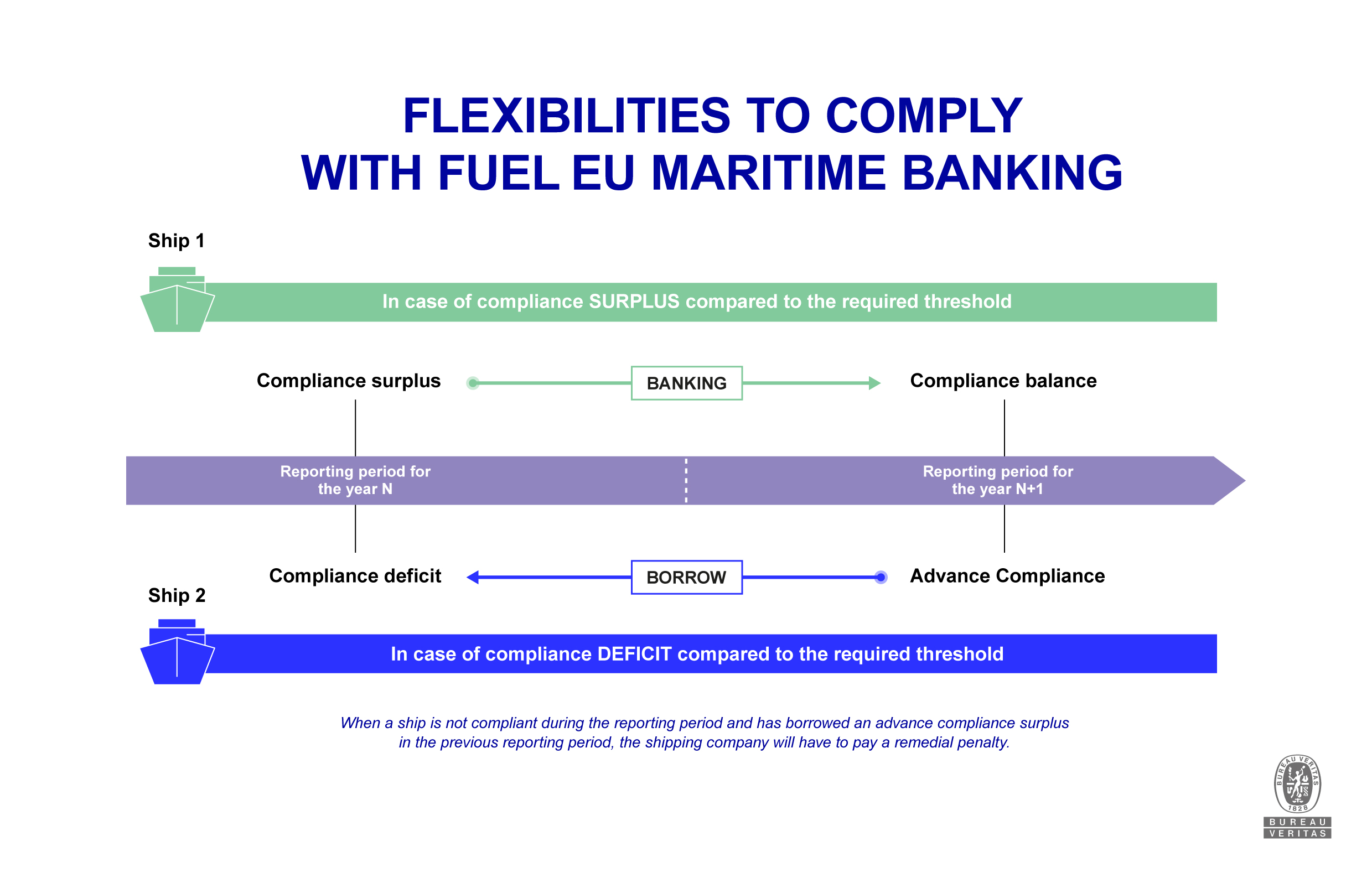
FuelEU Maritime allows for some flexibility. Shipping companies can also achieve compliance through banking, borrowing and pooling mechanisms.
For borrowing and banking:
- Ships can bank their compliance surplus within a given reporting period for the following period
- Ships can borrow an advance compliance surplus from the following reporting period to make up for a deficit
However, this mechanism is only granted with the verifier’s approval and is not applicable to:
- • Amounts exceeding the GHG intensity limit multiplied by the ship’s energy consumption by more than 2%
- Two consecutive reporting periods
When a ship is not compliant during the reporting period and has borrowed an advance compliance surplus in the previous reporting period, the shipping company will have to pay a remedial penalty.
Download our infographic
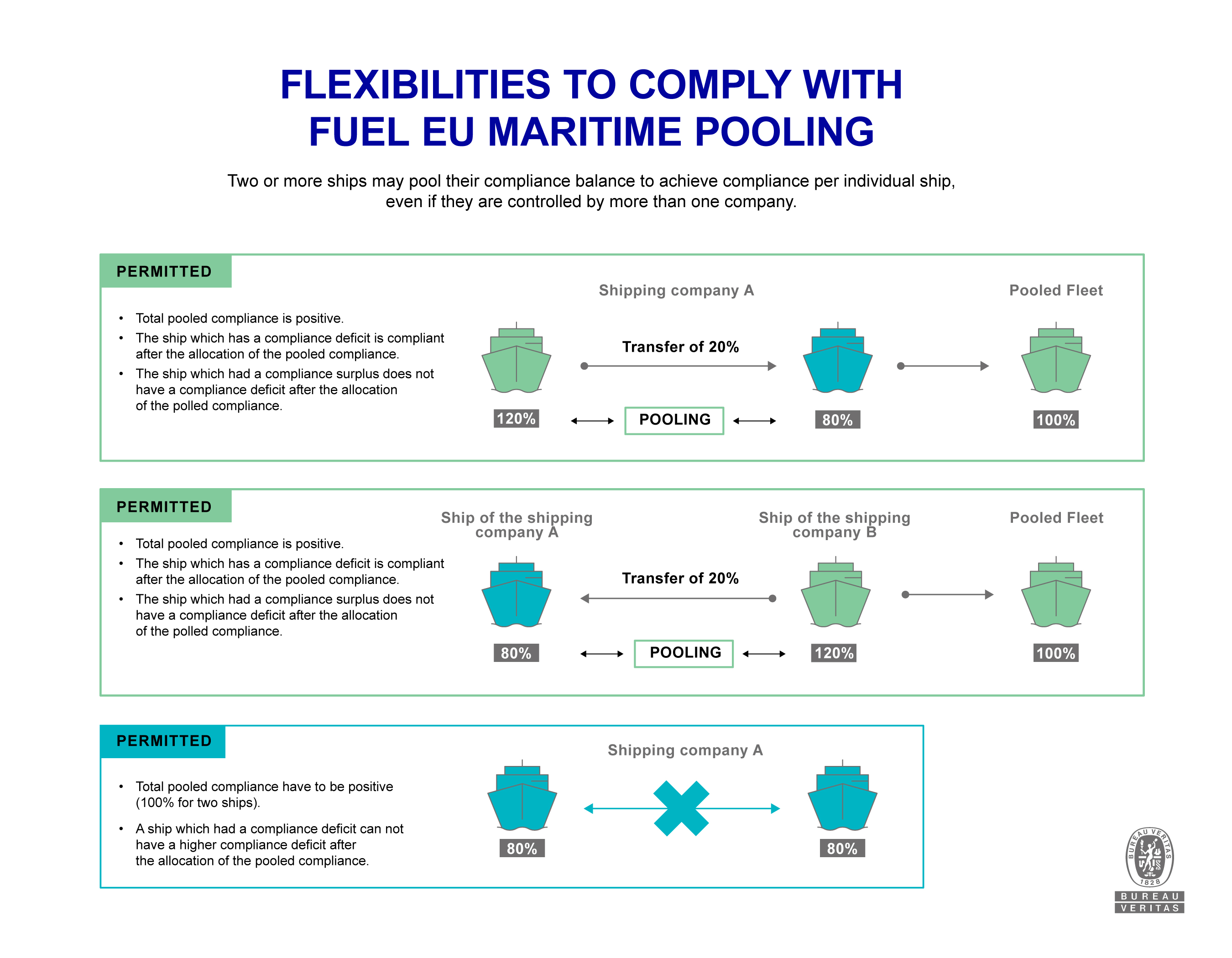
As for pooling: two or more verified ships may pool their compliance balance to achieve compliance per individual ship, even if they are controlled by more than one company.There are some restrictions:
- Ship compliance can only be included in one pool per reporting period
- The ship that uses the borrowing mechanism during year N-1 cannot be in a pool during year N
- The total pooled compliance must be positive. Ships that had a compliance deficit cannot increase their deficit as a result of the allocated pooled compliance
- Ships that had a compliance surplus cannot have a deficit as a result of the allocated pooled compliance
The pool’s compliance composition and allocation is recorded by the verifier in the FuelEU database by April 30 each year.
-
WHO IS RESPONSIBLE FOR ENSURING COMPLIANCE WITH FUELEU MARITIME?
The International Safety Management (ISM) Company (i.e. the Document of Compliance holder) is responsible for FuelEU Maritime compliance, whether they are the registered owner, a bareboat charterer or a third party technical manager.
For EU Monitoring, Reporting and Verification (MRV) and EU Emissions Trading System (ETS) compliance, the responsibility falls either under the ISM company or the registered owner (Implementing Act 2023/2599).
Penalties for non-compliance
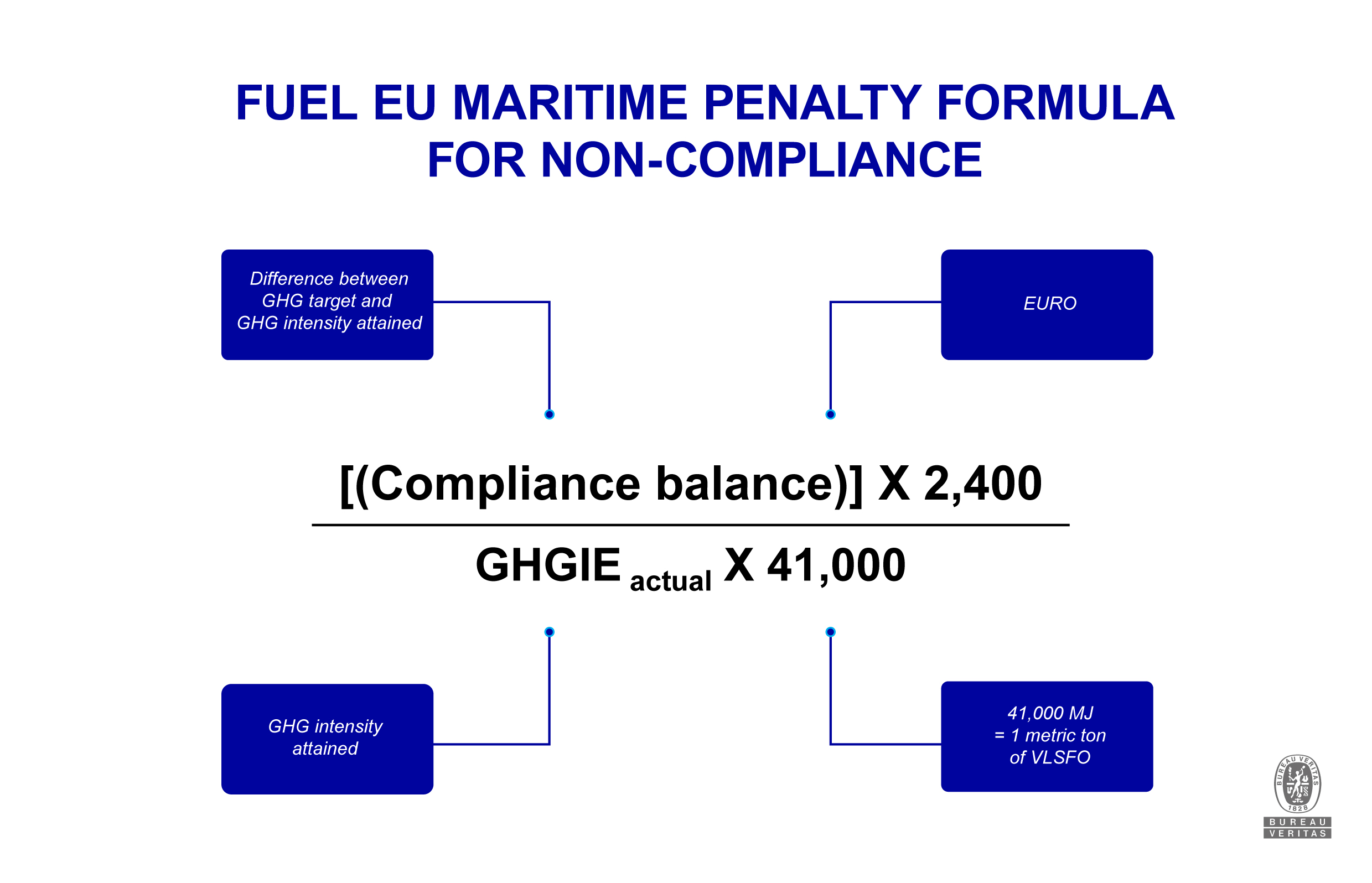
If a ship is found to be non-compliant with the limits on GHG intensity or the mandatory use of OPS, the shipping company is subject to penalties. The amount payable is calculated in the FuelEU database and must be paid to achieve compliance. Ships may be issued an expulsion order if they are non-compliant for two consecutive years.
FuelEU Maritime revenuesThe revenues from the payment of FuelEU penalties will be used for two purposes:
- Promoting the distribution and use of renewable and low-carbon fuels in the maritime sector
- Helping maritime operators meet their climate and environmental goals
To ensure revenues are being used as expected, EU Member States will be required to report transparently on how they are spent.
-
HOW CAN I KEEP UP TO DATE WITH FIT FOR 55 NEWS?
The FuelEU Maritime update is impacting shipping in EU waters, shaping both long-term fuel choices and short- to mid-term operational costs.
Bureau Veritas is helping ship owners and operators attain FuelEU Maritime compliance and make all necessary preparations for Fit for 55. As the text is revised and stricter requirements are implemented, we will provide updated information and advice. To stay up to date with the latest developments on FuelEU Maritime and other Fit for 55 measures, subscribe to our newsletter.