Wind propulsion
Harnessing wind propulsion to decarbonize maritime shipping
While the maritime industry plays a key role in the global economy, it is also a growing source of greenhouse gas (GHG) emissions, accounting for nearly 3% of global emissions each year. To reduce its environmental impact and decarbonize, the sector needs to rely on alternative energy solutions, such as wind propulsion.
Adoption of wind propulsion is already underway. By June 2026, over 100 ships had been equipped to harness wind energy. Experts also predict that up to 30% of the world’s fleet will embrace wind power by 2050 as fuel and carbon prices continue to rise.
As a classification society, Bureau Veritas is developing the rules to enable safe innovation and build the trust and support needed to scale the adoption of wind propulsion. We support our clients by assessing whether wind propulsion is suitable for their ships and helping them select the right technology.

Technology Leader, Sustainable Shipping
Bureau Veritas Marine & Offshore
Wind power is the oldest method of maritime power, yet has been largely replaced by cheaper, reliable fossil-fuel-powered engines. Now, as environmental concerns gain prominence, wind propulsion technologies hold great potential.
-
How does wind propulsion technology work?
Traditional ship propulsion systems combine propulsion machinery with auxiliary systems to produce the power needed for thrust.
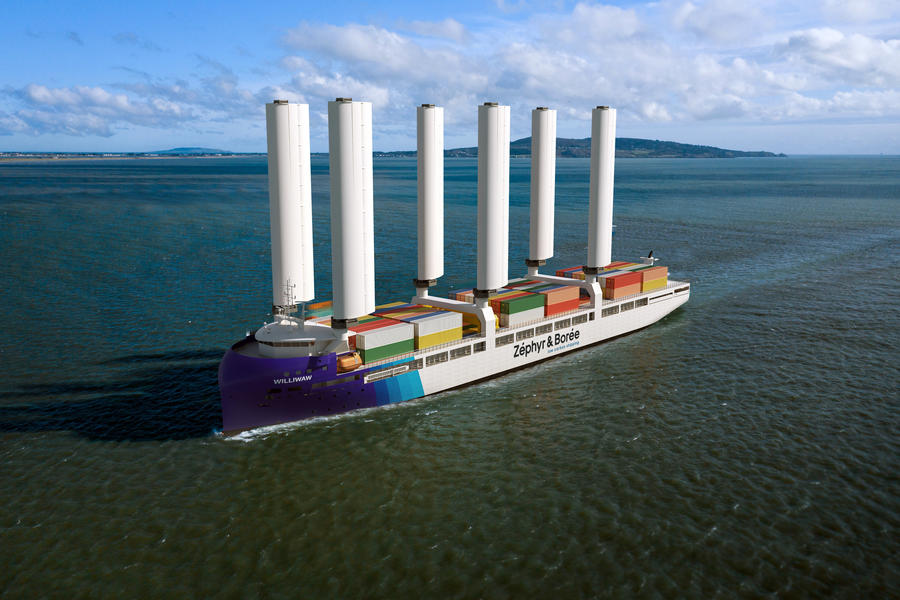
In contrast, wind propulsion systems directly harness wind energy to generate propulsive thrust without relying on engines. This helps shipowners save on fuel costs and meet decarbonization goals.
Two types of wind propulsion can be used onboard ships:
Assisted propulsion: the ship uses wind propulsion to supplement its main propulsion system, improving energy efficiency.
Main propulsion: the ship relies primarily on wind power for propulsion. Under ideal sailing conditions, its propulsive energy would come directly from the wind propulsion system.
-
Why use wind propulsion?
Wind propulsion holds many advantages over traditional propulsion systems.
Implementing wind propulsion systems can offer economic benefits for shipowners and operators. Although the upfront installation cost can be high, operating costs decrease once systems are fully functional due to reduced fuel consumption.
Wind propulsion systems also help shipowners meet their decarbonization targets by reducing carbon dioxide (CO2), nitrogen oxide (NOx) and sulfur oxide (SOx) emissions.
Additionally, wind power helps minimize engine vibrations, limiting underwater radiated noise, which can harm the ocean ecosystem.
-
What are the different types of wind propulsion systems?
There is a wide range of wind propulsion systems on the market. These systems can be categorized into two types:
Active systems require external energy for thrust generation. This includes rotor sails and suction wing sails.
Passive systems rely solely on wind energy for thrust generation. This includes wing sails, sailing rigs and kite sails.
Many of these technologies make use of automation, tilting systems, explosion-proof equipment, anti-icing techniques, weather routing or energy management, offering a range of options for equipping ships with wind propulsion capabilities.
Bureau Veritas supports wind propulsion system development
As a member of the International Windship Association (IWSA) and an active participant in EU, IMO and ISO Working Groups, Bureau Veritas is invested in the development of wind propulsion.
We continue to develop our NR 206 Rules for wind propulsion systems and WIND PROPULSION class notation to help shipowners and operators navigate the latest developments in wind propulsion. We also work to advance innovation in wind propulsion technology through Approvals in Principle (AiPs), assessing concept feasibility and ensuring there are no technical dealbreakers.
Our teams support clients in ensuring compliance with international regulations. Our relevant services cover:
- Wind power assessments according to IMO Circular 896, including wind force matrix validation
Calculation methodology review for EEDI/EEXI and FuelEU Maritime compliance
Our global Future Shipping Team is also available to guide maritime stakeholders, focusing on pragmatic, viable solutions for maritime decarbonization, including wind propulsion.
We offer the following advisory services for wind propulsion:
|
|
|
|
| |
| |
|
|
Advancing innovation with the world’s largest sailing cruise ship
The Orient Express Corinthian combines large-scale wind propulsion with luxury hospitality across a total sail area of 4,500 m2. The vessel started sailing in May 2026, marking a key milestone for this innovative and iconic maritime project.
Latest news
Bureau Veritas Issues Design Assessment for bound4blue's Model 3-24 eSAIL®
BV M&O delivered a Design Assessment for bound4blue's Model 3-24 eSAIL®, a wind propulsion technology designed to maximize the contribution of wind power on larger vessels.
K Shipbuilding and bound4blue’s WAPS Applied LR1 Tanker Verified by Bureau Veritas
K Shipbuilding Co., Ltd., bound4blue, and Bureau Veritas Marine & Offshore (BV) have entered into a Joint Development Project (JDP) for the development of a next-generation LR1 tanker incorporating Wind Assisted Propulsion System (WAPS) technology, marking a significant step forward in sustainable maritime innovation


